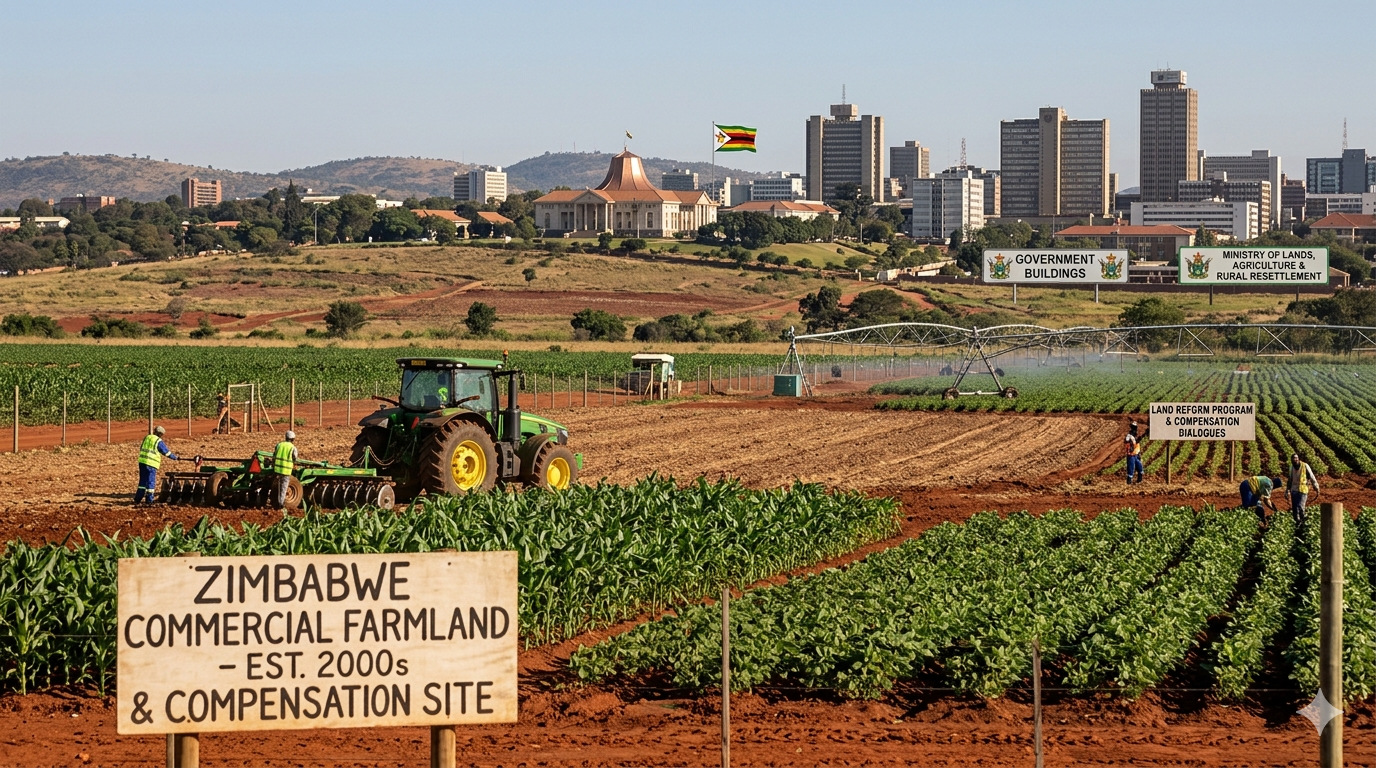
Zimbabwe Advances Compensation Framework for Former Farm Owners
Summary
More than two decades after Zimbabwe’s fast-track land reform programme transformed the country’s agricultural landscape, the government is continuing efforts to compensate former farm owners and resolve outstanding disputes linked to land acquisitions.
The process remains one of the most closely watched policy initiatives in Southern Africa, carrying significant implications for agriculture, investment, international relations and economic recovery.
What Has Been Announced?
Zimbabwe’s government has reaffirmed its commitment to compensating former commercial farm owners under agreements reached in recent years. The compensation programme forms part of a broader effort to address disputes arising from land acquisitions that took place during the early 2000s. Under the framework, compensation primarily relates to infrastructure and improvements made on the land rather than the land itself.
In addition, authorities have announced plans to return certain farms that were protected under bilateral investment agreements. Reports indicate that 67 farms covered by such treaties are expected to be restored to former owners while compensation payments are also being made to affected parties.
The measures form part of Zimbabwe’s wider strategy to improve investor confidence and normalise relations with international lenders and creditors.
Understanding the Historical Context
Land ownership has been one of Zimbabwe’s most sensitive issues since independence.
Supporters of land reform argue that redistribution was necessary to address colonial-era inequalities in land ownership. Before independence, a large proportion of productive agricultural land was owned by a relatively small number of commercial farmers, while the majority black population had limited access to land.
Critics, however, argue that the implementation of the programme contributed to declines in agricultural production, reduced investor confidence and increased economic instability during parts of the 2000s. The debate remains highly contested both within Zimbabwe and internationally.
Why Compensation Matters
For the government, resolving compensation claims is about more than addressing historical grievances.
Officials view the programme as an important step toward strengthening property rights, improving the investment climate and rebuilding confidence among international financial institutions. Finance Minister Mthuli Ncube has repeatedly stated that fulfilling compensation commitments remains a government priority.
The compensation arrangements are also intended to provide legal certainty around land ownership while helping close a chapter that has influenced Zimbabwe’s economy and international relationships for many years.
Debate Continues
Despite broad agreement that unresolved disputes should be addressed, opinions differ on how the process should unfold.
Some stakeholders argue that compensation demonstrates respect for constitutional obligations and the rule of law. Others believe discussions should also consider broader questions relating to colonial-era land dispossession and historical reparations. Academic research examining the issue notes that compensation and historical justice remain deeply interconnected topics within Zimbabwe’s national conversation.
Questions also remain regarding funding mechanisms, payment schedules and the long-term economic impact of the programme. Some farmer groups have expressed concerns about the pace of implementation and the structure of proposed settlements.
Economic Implications
Agriculture remains a critical sector of Zimbabwe’s economy, providing employment, export earnings and food production.
Analysts suggest that successfully resolving long-running land disputes could help improve confidence among both domestic and international investors. Greater certainty around property rights may also support future agricultural investment and productivity growth.
At the same time, the government faces the challenge of balancing compensation commitments with broader fiscal priorities in a difficult economic environment.
Key Facts
Compensation Programme
Zimbabwe agreed to a compensation framework valued at approximately US$3.5 billion for qualifying former commercial farmers, focusing primarily on improvements made to acquired land.
Bilateral Investment Agreements
Certain farms covered by international investment treaties are being treated separately under constitutional and treaty obligations.
Investor Confidence
The government hopes the programme will support economic reforms and strengthen relationships with creditors and international partners.
Impact
The compensation process represents one of the most significant policy initiatives currently underway in Zimbabwe.
Whether viewed through the lens of economic reform, constitutional obligations, agricultural development or historical justice, the decisions made in the coming years are likely to influence Zimbabwe’s trajectory for decades to come.
While debate over land reform itself remains unresolved, the government’s focus has increasingly shifted toward finding practical mechanisms to address outstanding claims and provide greater certainty for the future.